SAML 2.0 single sign-on
Strata can sign users in through a SAML 2.0 identity provider (Keycloak, Okta, Entra ID, ADFS, …) in addition to OIDC. It is a deliberately small service provider: SP-initiated login, HTTP-Redirect AuthnRequest, HTTP-POST Response, XML-DSig verification and the same one-time-code hand-off to the SPA that the OIDC flow uses. No OpenSAML dependency — the JDK XML-DSig APIs do the signature work, so the framework stays light.
SAML is disabled by default. Configure it with
strata.saml.*and enable it only when an IdP is provisioned.
What is supported
| Capability | Implementation |
|---|---|
| SP-initiated login | GET /saml2/authenticate builds a signed-request-free AuthnRequest (deflate + base64, HTTP-Redirect) |
| Response handling | POST /saml2/acs (HTTP-POST binding), one assertion per response |
| Signature | XML-DSig (RSA-SHA256/384/512 + SHA-1 legacy) against the IdP certificates from metadata; signature must cover the Response or the Assertion |
| Validation | Status, issuer, audience, recipient, NotBefore/NotOnOrAfter, InResponseTo, clock skew |
| Identity mapping | NameID email, or an email/mail/urn:oid:1.2.840.113549.1.9.1 attribute; users are matched by email and auto-provisioned |
| Session hand-off | ACS redirects to /sso-callback?provider=saml&code=…; the SPA exchanges the one-time code for normal JWT tokens |
| Role assignment | strata.saml.default-role-code is granted to auto-provisioned users |
| State store | memory (single instance) or redis (multi-instance) for RelayState and login codes |
Not supported (use OIDC or a gateway if you need them): IdP-initiated login, Single Logout, encrypted assertions, artifact binding, SP metadata publishing and advanced attribute mapping.
Configuration
strata:
  saml:
    enabled: true
    display-name: Keycloak SAML          # login button label
    # Either point at the IdP metadata (cert + SSO URL are read from it)…
    idp-metadata-uri: http://keycloak:8080/realms/strata/protocol/saml/descriptor
    # …or set the values explicitly:
    # idp-entity-id: http://localhost:8082/realms/strata
    # idp-sso-url: http://localhost:8082/realms/strata/protocol/saml
    # idp-certificates: [MIIC…]
    sp-entity-id: strata-saml
    acs-url: http://localhost:3001/saml2/acs
    frontend-callback-url: http://localhost:3001/sso-callback
    default-role-code: admin             # empty = no role until an admin assigns one
    auto-provision: true
    state-store: memory                  # redis for multiple backend replicas
    code-ttl-seconds: 60
    clock-skew-seconds: 120
| Property | Description |
|---|---|
enabled |
Master switch; all SAML endpoints are absent when false |
display-name |
Button text on the login page |
idp-metadata-uri |
IdP metadata URL, fetched at startup (recommended); the browser-facing SSO URL inside metadata is used for redirects |
idp-entity-id, idp-sso-url, idp-certificates |
Explicit alternative to metadata; certificate is base64 DER (PEM body) |
sp-entity-id |
SP entity id / Issuer; must match the IdP client id |
acs-url |
Browser-facing Assertion Consumer Service URL registered at the IdP |
frontend-callback-url |
Frontend route that exchanges the one-time code |
default-role-code |
RBAC role code granted to auto-provisioned users |
auto-provision |
Create users that do not exist yet; otherwise login fails |
state-store |
memory or redis |
code-ttl-seconds / clock-skew-seconds |
One-time code lifetime / allowed clock skew |
Keycloak demo
The SSO overlay starts Keycloak with both an OIDC and a SAML client, and the Strata backend with SAML enabled:
docker compose -f docker-compose.yml -f docker-compose.sso.yml up --build
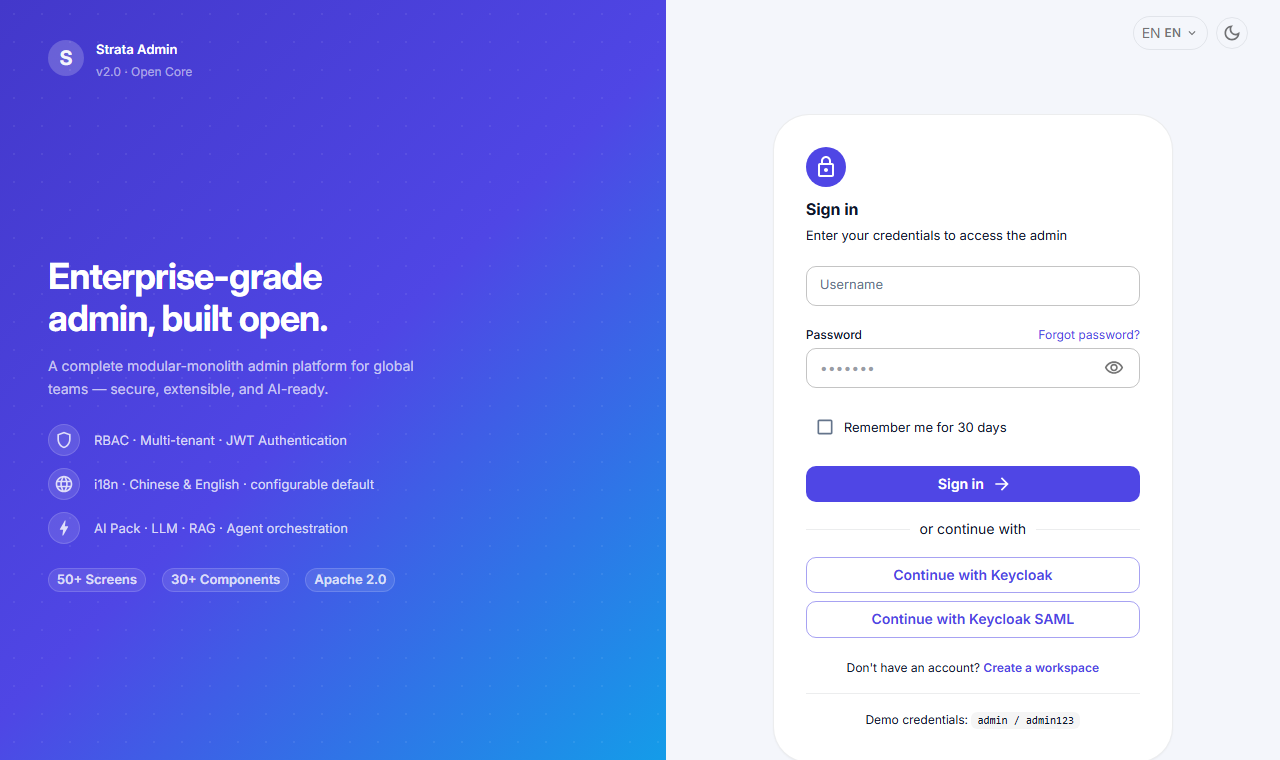
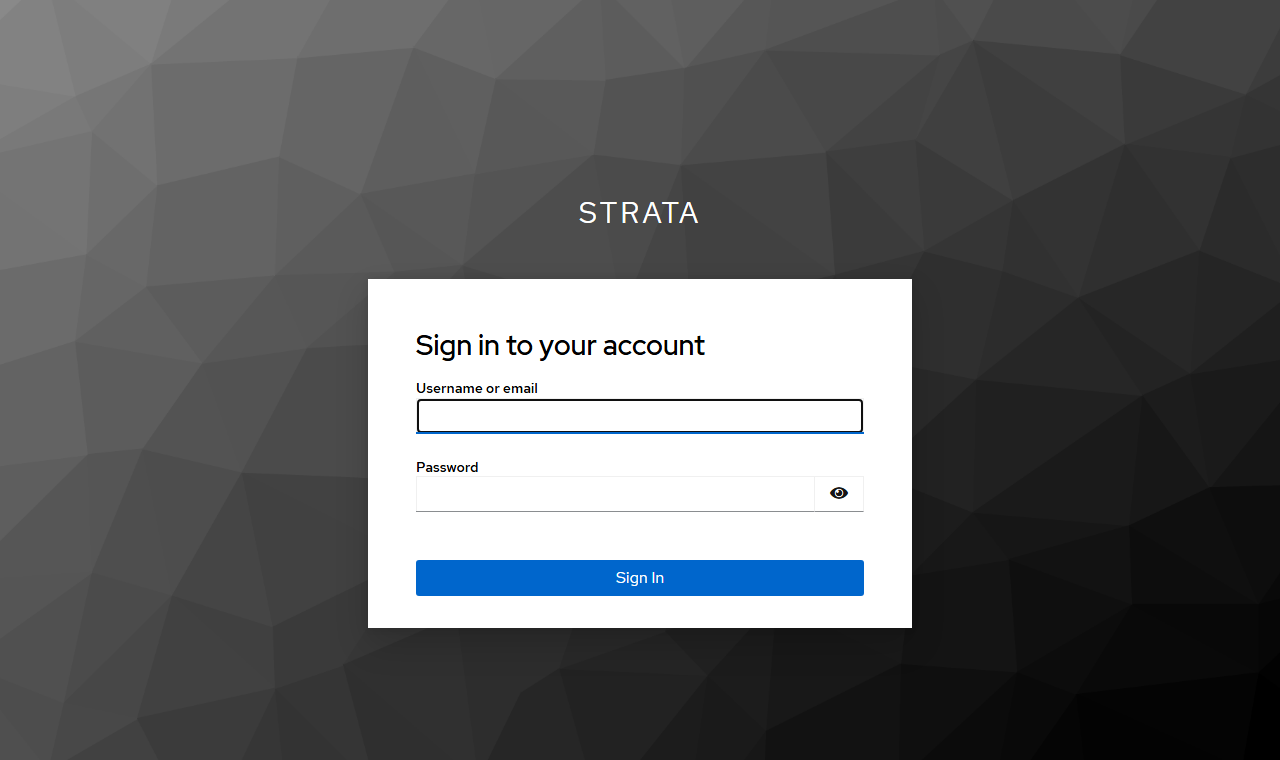
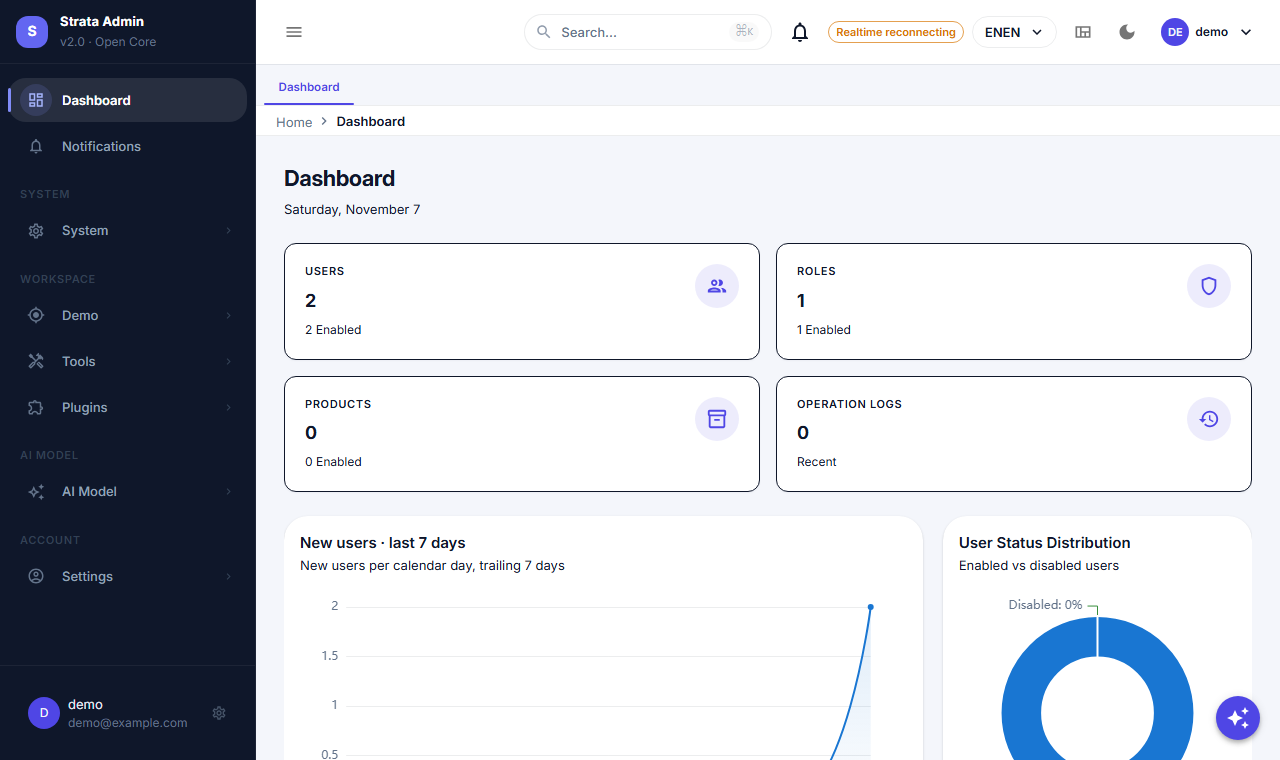
Open http://localhost:3001, click Continue with Keycloak SAML, sign in with demo / demo123. The first SAML
login auto-provisions the user from the assertion email and grants the admin role. The same Keycloak user can also
use the OIDC button.
| Login page | IdP | After SAML sign-in |
|---|---|---|
 |
 |
 |
To wire your own Keycloak: create a SAML client with client id = sp-entity-id, set Valid redirect URIs and
Assertion Consumer Service POST Binding URL to acs-url, set Name ID format to email, and add an
email attribute mapper (saml-user-property-mapper) so the backend can map the user. The backend can consume the
realm metadata directly, so no certificate needs to be copied.
Security notes
- XML parsing disables DTDs/external entities; signatures are verified with the JDK XML-DSig implementation against the IdP certificate from metadata (not against a certificate embedded in the response).
- Exactly one assertion is accepted, and its content must be covered by a verified enveloped signature over the Response or the Assertion itself — unsigned or wrapped assertions are rejected.
Audiencemust equalsp-entity-id,Recipientmust equalacs-url, andInResponseTomust match the AuthnRequest id stored for the RelayState (single use).- The one-time code is consumed exactly once and exchanged server-side for normal JWT tokens; the refresh token is never exposed in a URL.
- Login/ACS/exchange endpoints are rate limited. Use HTTPS in production and rotate the demo credentials.
- With multiple backend replicas set
state-store: redis(the demo overlay uses Redis).
Troubleshooting
| Symptom | Cause / fix |
|---|---|
| Keycloak 400 Invalid redirect uri | The SAML client's ACS URL/valid redirect URI must equal acs-url (scheme, host and port) |
| SAML assertion has no email identity | Add an email attribute mapper or set the NameID format to email in the IdP client |
| SAML signature is missing or invalid | idp-metadata-uri points at the wrong realm or its certificate is stale; metadata is cached at startup, restart the backend after rotating IdP keys |
| SAML assertion has expired | Clock drift; increase clock-skew-seconds (or fix NTP) |
| Login loops back with a 401 | The backend could not load metadata at startup — check idp-metadata-uri reachability from the backend |