SSO / OpenID Connect
Enterprise single sign-on for the admin console: authorization code + PKCE, exchanged server-side, mapped to the normal JWT/RBAC session. Disabled by default.
How it works
browser                admin backend                     provider
   |  GET /social/config    |                                |
   |----------------------->|  enabled? providers?           |
   |  GET /social/authorize |  mint state + PKCE verifier    |
   |----------------------->|  discovery (issuer)            |
   |  302 authorize URL     |                                |
   |------------------------------------------------------->|
   |  provider redirects back to /sso-callback?code&state   |
   |  POST /social/callback |  verify state, exchange code   |
   |----------------------->|------------------------------->|
   |                        |  userinfo (access token)       |
   |                        |  find/provision user, RBAC     |
   |  framework JWT session |                                |
   |<-----------------------|                                |
- The client secret and PKCE verifier never reach the browser; only
stateandcodetravel through the redirect. - Identity comes from the provider's
userinfoendpoint; the ID token is not trusted as an authorization source. - The user is matched by verified email; unknown emails can be auto-provisioned with a default role.
- The issued session is a normal framework JWT, so RBAC menus/authorities work unchanged.
Configuration
strata:
  social:
    enabled: true
    # Exact browser redirect URIs (open-redirect guard). Include every origin you deploy:
    allowed-redirect-uris:
      - https://admin.example.com/sso-callback
      - http://localhost:5173/sso-callback
    providers:
      keycloak:                                  # id used by the admin UI
        display-name: Keycloak                   # button label
        issuer-uri: https://id.example.com/realms/main
        client-id: strata-admin
        client-secret: ${OIDC_CLIENT_SECRET}      # keep out of YAML
        scopes: [openid, email, profile]
        default-role-code: viewer                # fallback role for auto-provisioned users ("" = none)
        auto-provision: true                     # false = only pre-created emails may log in
        require-verified-email: true             # reject unverified emails
        roles-claim: groups                      # dot paths reach nested claims, e.g. realm_access.roles
        role-mappings:                           # external group/role -> framework role code
          platform-admins: admin
          support-team: viewer
        sync-roles: false                        # true = provider roles are authoritative on every login
Endpoints are discovered from issuer-uri (/.well-known/openid-configuration). If your provider has no discovery
document, set them explicitly:
        authorization-endpoint: https://id.example.com/authorize
        token-endpoint: https://id.example.com/oauth/token
        user-info-endpoint: https://id.example.com/userinfo
The admin UI must be reachable at the configured redirect URI. The SPA always uses
${origin}/sso-callback, so add one entry per origin (dev and production).
Try it locally with Keycloak
The repository ships an optional compose overlay with a Keycloak realm (client + a demo user) configured for the
admin console:
git clone https://github.com/simplezac1995/strata.git
cd strata
docker compose -f docker-compose.yml -f docker-compose.sso.yml up --build
Open http://localhost:3001, click Continue with Keycloak, sign in as demo / demo123.
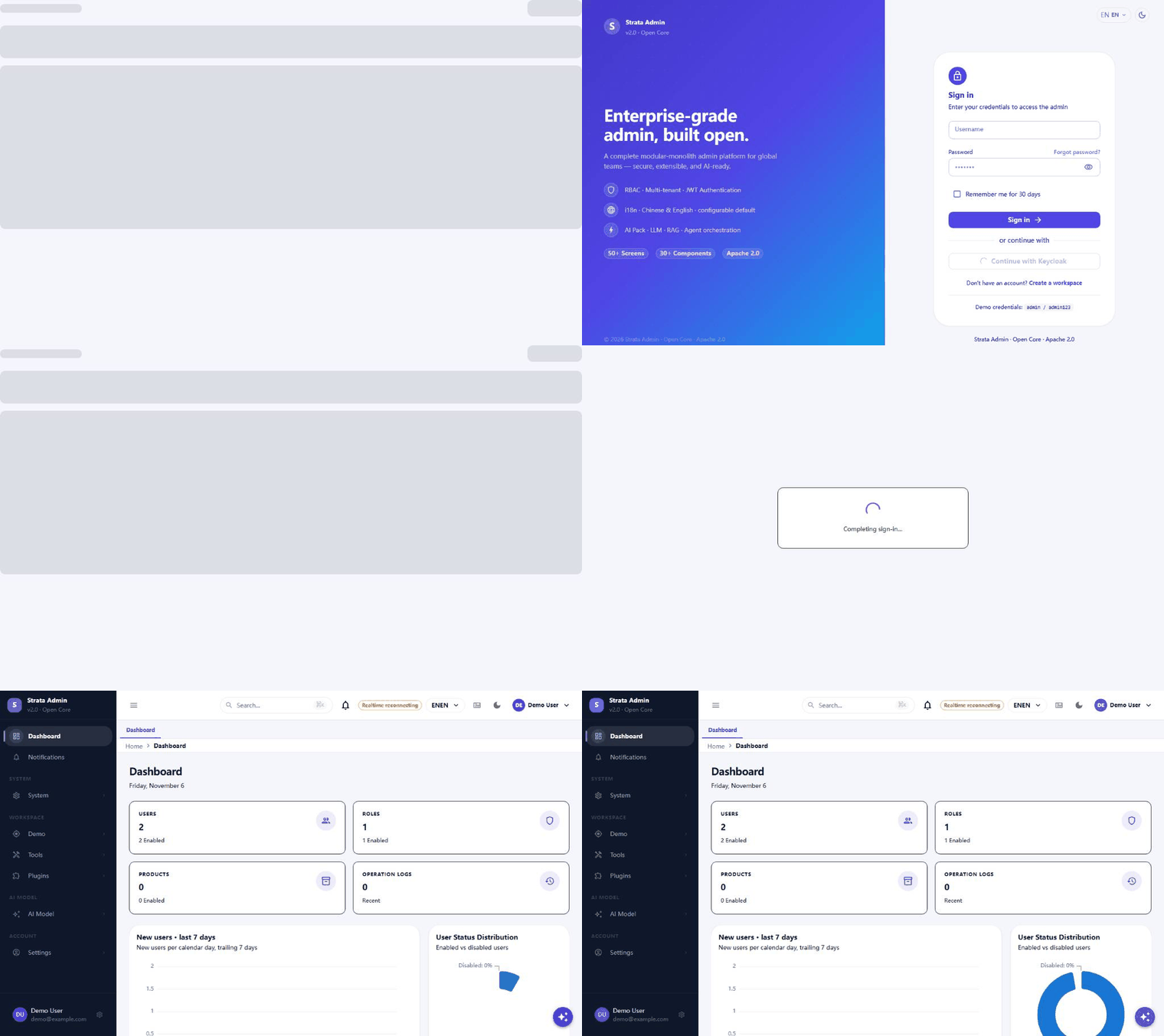 The realm import
(
deploy/keycloak/strata-realm.json) creates the strata-admin client (redirect URI
http://localhost:3001/sso-callback), and the backend overlay enables the provider with
state-store: redis. Password login (admin / demo-admin-password) keeps working alongside SSO.
Endpoints
| Method | Path | Purpose |
|---|---|---|
| GET | /api/v1/system/auth/social/config |
Public: enabled, provider list (id + display name), allowed redirect URIs |
| GET | /api/v1/system/auth/social/authorize?provider=…&redirectUri=… |
Public: mints one-time state + PKCE, returns the provider authorize URL |
| POST | /api/v1/system/auth/social/callback |
Public: {provider, code, state} → framework tokens |
The login page shows one button per configured provider; clicking it starts the redirect and /sso-callback completes
the flow.
Group / role mapping
Provider groups (Keycloak groups, Auth0 roles, Entra groups, …) can drive framework RBAC:
roles-claimnames the claim holding the external values; dot paths traverse nested objects, so Keycloak'srealm_access.rolesworks as-is (add a group-membership mapper in Keycloak if you prefer a flatgroupsclaim).role-mappingsmaps each external value to a framework role code (sys_role.code, e.g.admin,viewer). Unknown values are ignored; the role must exist and be enabled.- On first login (
auto-provision: true) the mapped roles are granted.default-role-codeis the fallback when no mapping matches. sync-roles: truemakes the provider authoritative for existing users too: every login reconciles their roles to the mapped set (roles added and removed). Leave it off if local administrators also manage roles; when the provider sends no mapped roles at all, existing roles are left untouched.
User provisioning
| Provider claim | Used as |
|---|---|
email |
Identity key (required; verified unless require-verified-email: false) |
name |
Nickname of a newly provisioned user |
preferred_username |
Local username (sanitized, uniquified); falls back to the email local-part |
Existing users keep their roles. Auto-provisioned users get default-role-code when configured; without it they can
log in but see no menus until an admin grants a role.
Security notes
- Server-side code exchange with the client secret + PKCE S256; state is one-time and expires.
- Redirect URIs are matched exactly against the whitelist.
- Login/callback endpoints are rate-limited; login attempts are recorded in the framework login log.
- State is stored in-process by default; for more than one instance set
strata.social.state-store: redisand provide aStringRedisTemplate(the demo compose already includes Redis). Redis mode uses atomic GETDEL and a 10-minute TTL. - Keep
client-secretin an environment variable or the field-encryption plugin, never in the repository.
Need SAML instead? See SAML 2.0 for the SP-initiated SAML flow (Keycloak demo included).
Troubleshooting
| Symptom | Fix |
|---|---|
| Login page shows no SSO buttons | strata.social.enabled: true + at least one provider with client-id |
| Provider says "invalid redirect_uri" | The exact URI must be registered at the provider and in allowed-redirect-uris |
FEATURE_NOT_ENABLED on callback |
Provider unknown, enabled false, or discovery failed (check issuer URI) |
SSO identity email is not verified |
Provider user has an unverified email; fix the account or set require-verified-email: false |
SSO user does not exist and auto-provisioning is disabled |
Create the user first or set auto-provision: true |
| 401 after callback | Check server clock, client secret, and that the token endpoint accepts client_secret_post |